
Flying Smarter: Three Ways to Reduce Your Travel Footprint Without Flying Less
Travel has the power to connect cultures, support local economies, and inspire a greater appreciation for our planet. At Yotta Travel, we believe exploring the world and protecting it should go hand in hand. While aviation contributes approximately 2–3% of global carbon dioxide emissions, every traveller can make choices that meaningfully reduce their environmental impact.
Here are three of the most effective ways to fly with a lower footprint.
1. Choose Economy Class Whenever Possible
One of the biggest factors affecting your personal carbon footprint isn't the aircraft itself, it's where you sit.
Business and first-class seats occupy significantly more cabin space than economy seating. Because fewer passengers can be carried in the same aircraft, the emissions associated with each premium seat are substantially higher. Depending on the aircraft and route, a business-class passenger may be responsible for two to four times the emissions of an economy passenger.
The example below illustrates this difference using the same Air France Airbus A350 flight from Vancouver (YVR) to Paris (CDG).
Economy Class
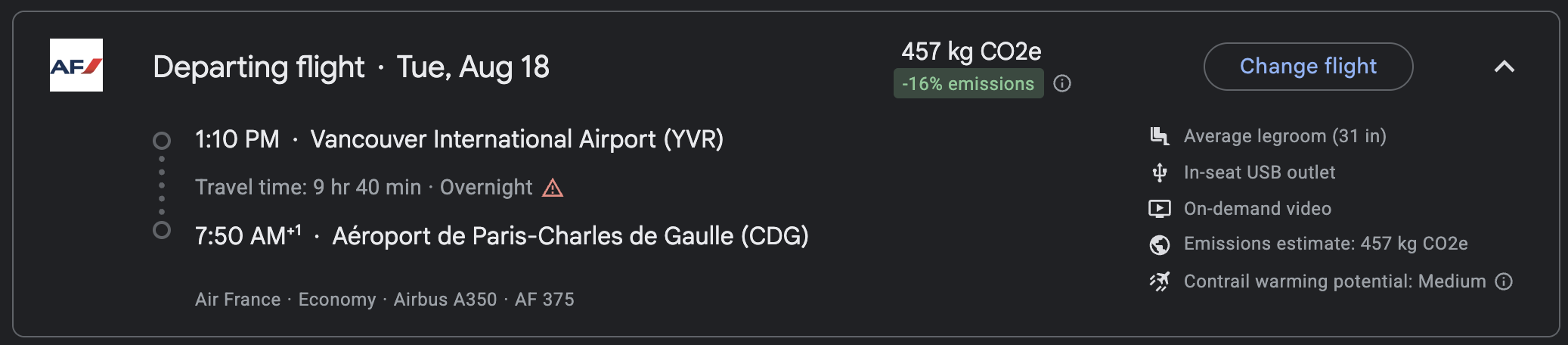
Estimated emissions: 457 kg CO₂e per passenger.
Business Class
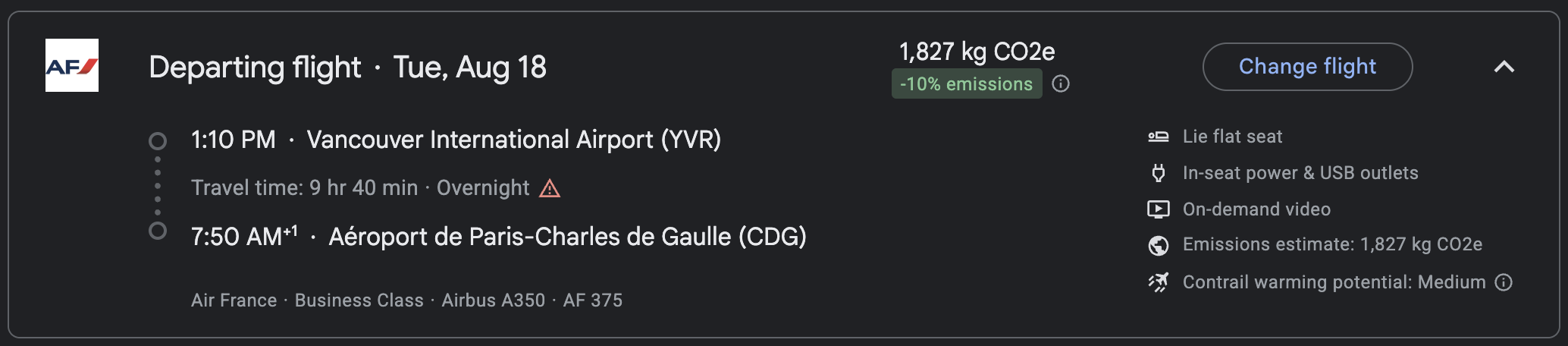
Estimated emissions: 1,827 kg CO₂e per passenger.
For this particular itinerary, choosing economy instead of business reduces estimated emissions by approximately 75%, or about 1.37 tonnes of CO₂e for a single one-way journey. That reduction is equivalent to avoiding the emissions associated with driving many thousands of kilometres in a typical passenger vehicle.
This doesn't mean you should never fly or never enjoy premium travel. Rather, it highlights how one decision can substantially reduce the environmental impact of a trip. If additional comfort is important on long-haul flights, premium economy often provides a practical compromise by offering more legroom while maintaining a much smaller footprint than business class.
Yotta Tip: When booking flights, compare the estimated carbon emissions shown by Google Flights or your airline. If your budget allows for an upgrade, consider investing the savings from flying economy into experiences at your destination instead of a larger seat on the aircraft.
2. Offset What You Can't Avoid
Some greenhouse gas emissions are unavoidable, particularly when travelling long distances by air. While reducing emissions should always be the first priority, carbon offsetting can provide an additional way to help finance climate action for emissions that cannot reasonably be avoided.
A carbon offset represents one metric tonne of carbon dioxide (or its equivalent) that has been either removed from the atmosphere or prevented from being released elsewhere. When you purchase an offset, your money helps fund projects such as reforestation, renewable energy, methane capture from landfills, or ecosystem restoration. These projects are independently measured, verified, and issued carbon credits that correspond to the amount of emissions reduced or removed.
For example, the flight shown below from Vancouver to Paris is estimated to produce approximately 1.53 tonnes of CO₂e. Using a verified offset provider, that amount can be offset for approximately $37 CAD, with the funds supporting projects certified under internationally recognized standards such as Gold Standard or Verra's Verified Carbon Standard.
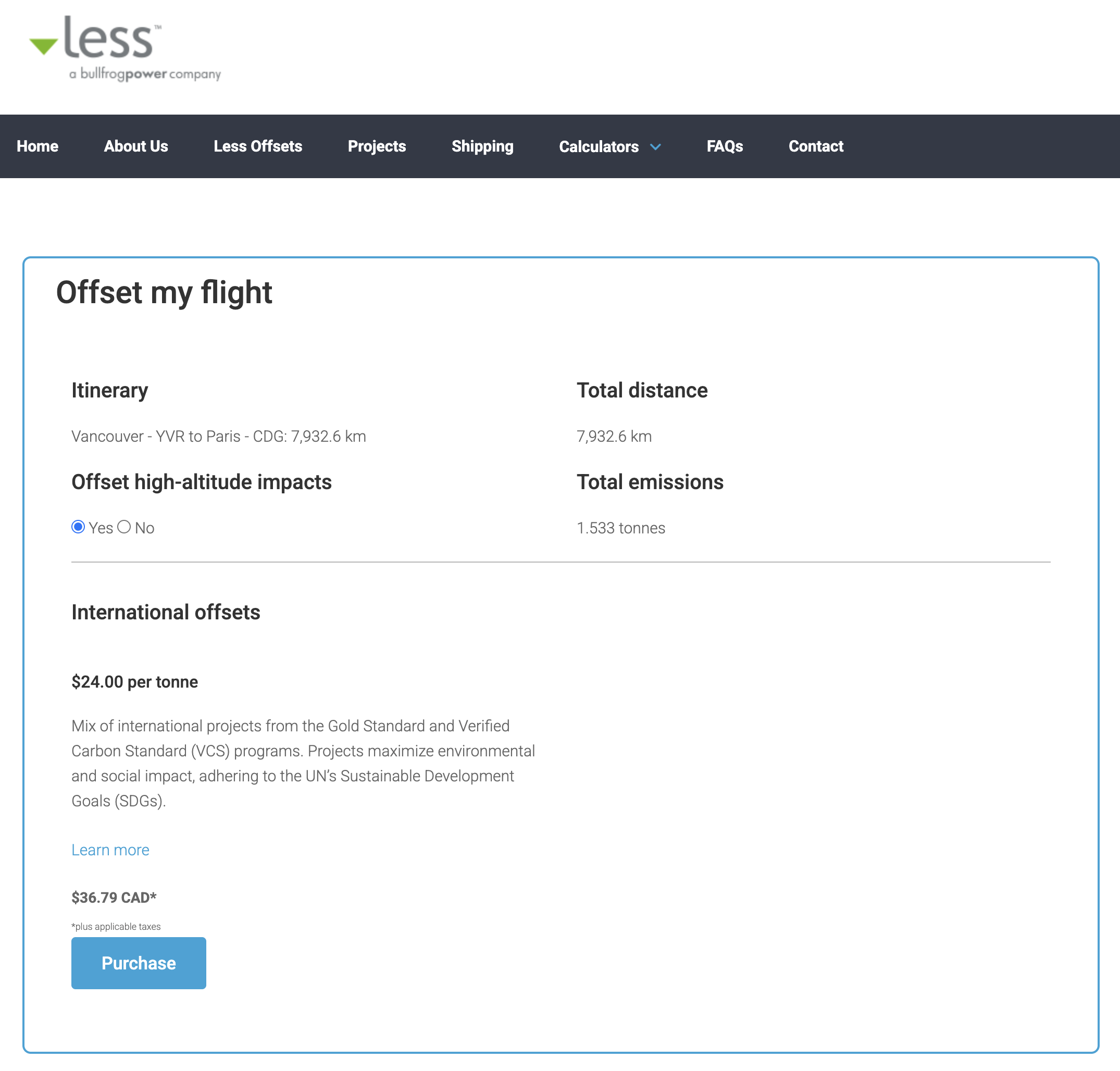
Example of a verified carbon offset calculator estimating the emissions from a one-way flight between Vancouver (YVR) and Paris (CDG).
How Carbon Offsets Work
Imagine two separate activities.
Your flight releases carbon dioxide into the atmosphere.
Elsewhere, a verified conservation or renewable energy project prevents an equivalent amount of greenhouse gases from entering the atmosphere or actively removes carbon that would otherwise remain there.
Although these actions occur in different locations, the atmosphere is a globally mixed system. From a climate perspective, reducing one tonne of carbon dioxide anywhere has the same physical effect on atmospheric concentrations as preventing one tonne from being emitted somewhere else, provided the reduction is real, measurable, additional, permanent, and independently verified. These principles form the scientific foundation of carbon offsetting.
However, not every carbon credit meets these standards. Recent research has shown that some offset projects have overestimated their climate benefits or failed to demonstrate that the emissions reductions would not have occurred anyway. This concept, known as additionality, is one of the most important indicators of offset quality. For this reason, travellers should choose programs that use transparent methodologies and third-party verification rather than relying solely on marketing claims.
Carbon offsets should therefore be viewed as a complement to reducing emissions, not a substitute for it. Choosing direct flights, travelling with only a carry-on backpack, flying economy, and using public transportation will usually have a greater impact than purchasing offsets alone.
Yotta Tip: Reduce first, offset second. The most effective strategy is to minimize your emissions wherever possible and use high-quality, independently verified offsets only for the emissions that remain.
3. Think Beyond the Flight
Reducing your footprint doesn't end when you board the aircraft.
Small choices throughout your journey can collectively make a meaningful difference:
Pre-order a plant-based meal whenever available. Plant-based meals generally require fewer natural resources and produce substantially lower greenhouse gas emissions than meals centred on beef or lamb.
Pack lighter. Every kilogram carried by an aircraft increases fuel consumption over thousands of kilometres.
Bring a reusable water bottle, coffee cup, utensils, and headphones to reduce single-use waste.
Stay longer and travel slower. One longer trip generally has a lower environmental impact than several short flights throughout the year.
Choose accommodations with credible sustainability certifications and support locally owned restaurants and businesses whenever possible.
Yotta Tip: Sustainability isn't about perfection. It's about consistently making better choices.
Beyond Carbon Offsetting
Carbon offsets are one way to support climate action, but they are not the only option. Another approach is to direct your money toward the transition to a low-carbon economy.
For example, investing in renewable energy funds, green bonds, or companies that are raising capital to build new solar, wind, battery storage, or clean energy infrastructure can help finance technologies that reduce future greenhouse gas emissions. While buying shares of an existing public company on the stock market does not usually provide new funding to that company, supporting new capital raises and investment vehicles dedicated to clean energy can contribute to expanding renewable energy capacity.
Whether you choose to offset your emissions, invest in clean technologies, or do both, the most effective strategy remains the same: reduce emissions where possible, then support credible solutions for the emissions you cannot yet avoid.
Every Journey Matters
No single traveller can eliminate aviation's environmental impact, but millions of travellers making smarter decisions can have a measurable effect.
Flying economy, supporting credible carbon-offset projects, choosing plant-based meals, packing lighter, and travelling thoughtfully are simple actions that reduce your footprint while allowing you to continue experiencing the world.
At Yotta Travel, we believe that extraordinary travel and environmental responsibility can—and should—go together. Every journey is an opportunity to leave a positive impression on the places we visit and the planet we all share.